Teatro Farnese

Covers Parma's churches, museums and walks, with tickets and hours checked against the official pages on the date shown.
UpdatedThis page carries dated prices or seasonal dates checked on the date above, and that window has now passed. Re-check the sources at the foot of the page before you book anything.
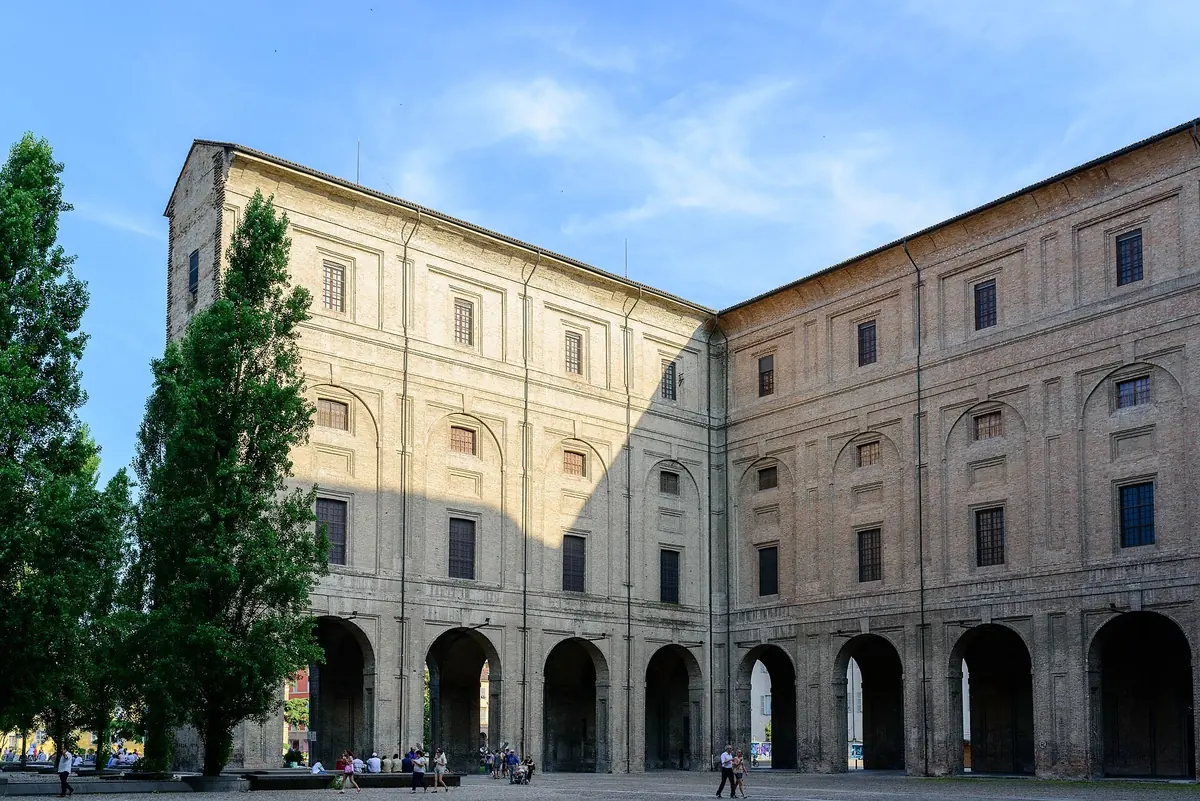
The Teatro Farnese is a vast court theater built inside the Palazzo della Pilotta. There is no separate ticket: it is one of the five museums on the Pilotta's €18 ticket, and the complex describes it as part of the exhibition route and the way into the Galleria Nazionale collections. Enter from 5 p.m. and the same ticket is €10. Under-18s go free, ages 18 to 24 pay €2, and the first Sunday of every month is free for everyone. The Pilotta is open Tuesday to Sunday, 9 a.m. to 7 p.m., last entry 6 p.m., and closed on Mondays.
What you see is a reconstruction, and an honest one. Giovan Battista Aleotti built the theater in 1617 to 1619 out of painted wood, stucco and even straw, made to look like marble and gold. Allied bombs hit the Pilotta on May 13, 1944 and badly damaged it. Rebuilding began in 1953 and was complete in 1965. Much of the wood you see is therefore postwar; knowing that makes the room more interesting, not less.
At a glance
- Admission
- Included in the Pilotta ticket: €18, or €10 from 5 p.m. €2 for ages 18 to 24, free under 18 and on the first Sunday of the month. No theater-only ticket.
- Hours
- Pilotta hours: Tuesday to Sunday, 9 a.m. to 7 p.m., last entry 6 p.m. Closed Mondays.
- How you enter
- Through the Pilotta's main entrance at Piazza della Pilotta 5. The theater is part of the route into the Galleria Nazionale.
- Time needed
- 25 to 30 minutes in the theater itself; two hours if you continue through the Galleria.
- Photos
- Personal photos and video allowed without flash, tripod or selfie stick.
- Access
- The Pilotta lists the Teatro Farnese as reachable by ramps, lifts and stair lifts.
In this guide
A theater built for a visit that never happened
Duke Ranuccio I Farnese commissioned the theater to celebrate a visit by Cosimo II de' Medici. The visit never took place. The theater sat unused for a decade, until the wedding of Duke Odoardo Farnese and Margherita de' Medici in 1628 gave it an opening night: a spectacle called Mercurio e Marte with music by Claudio Monteverdi.
That opening included a naumachia, a mock naval battle staged by flooding the floor of the auditorium. The Pilotta's own history of the theater records it. Imagine the U-shaped floor you walk across under water, with boats on it, lit by torches in a building made of wood.
The numbers are large for a room made so quickly. The stage is 40 m (131 feet) deep with a proscenium opening of 12 m, and the fourteen tiers of seating held more than 3,000 spectators. It was used very rarely, which is part of why it survived until the war.
What to look at in 25 minutes
- The horseshoe of tiers. Take in the stepped seating from the floor, then look down its length to the stage. This is the view the dukes' guests had.
- The double order of arcades running around the top of the seating, with statues in the niches, all imitation stone made of wood and stucco.
- The proscenium arch, with the Farnese arms. Stand on the auditorium floor and look back through it into the depth of the stage.
- The exhibition galleries along the side. The Pilotta runs two sections called the Galleria del Teatro: one on how the Farnese was invented, one on the court festivals staged here.
From here the route continues into the Galleria Nazionale, where Correggio, Parmigianino and Leonardo's La Scapigliata hang. Our Correggio and Parmigianino walk picks up from that point.
Are there performances in the Teatro Farnese?
Not as a regular program. The Pilotta presents the theater today as a museum space and the entrance to the Galleria, not as a working stage, and it publishes no season. Concerts and events are occasionally held here and are announced on the Pilotta's own events page; we found none listed for autumn 2026 when we checked on September 29.
If you want a night at the opera, that happens a few minutes' walk away at the Teatro Regio, whose autumn season includes Festival Verdi. The two buildings tell one story: the Farnese is the 17th-century court theater, the Regio the 19th-century public opera house built for Marie Louise.
When to go
The theater is at its best nearly empty, when you can hear your own steps on the boards. Two options help:
- Early. The Pilotta opens at 9 a.m. Go straight to the theater before school groups reach it. Note that the Galleria's north rooms do not open until 10:30 a.m., so start in the theater anyway.
- Late and cheap. The €10 ticket from 5 p.m. gives you an hour before last entry at 6 p.m. and up to two hours inside. That is enough for the theater and the Galleria's highlights.
Avoid the free first Sunday if you want quiet: the Pilotta warns that some areas may close or keep shorter hours on free days, and free tickets are issued only at the desk, not online. The next free Sundays are October 4, November 1 and December 6, 2026.
Photos, bags and access
You can take photos and video for personal use, without flash, tripods or selfie sticks. Only small bags are allowed; larger ones go into free lockers at the ticket office. The Pilotta lists the Galleria Nazionale, Teatro Farnese, Archaeological Museum and Biblioteca Palatina as accessible by ramps, lifts and stair lifts.
For the rest of the complex, what the ticket includes and a two-hour plan, see our Palazzo della Pilotta page. For a whole day in the center, it slots into our Parma in one day plan.
Frequently asked questions
How much does it cost to see the Teatro Farnese?
There is no separate ticket. The theater is included in the Pilotta ticket: €18 full price, €10 from 5 p.m., €2 for ages 18 to 24, free for under-18s and on the first Sunday of each month. Prices checked on the official site on September 29, 2026.
When was the Teatro Farnese built?
Giovan Battista Aleotti built it in 1617 to 1619 for Duke Ranuccio I Farnese. It opened in 1628 for the wedding of Odoardo Farnese and Margherita de' Medici. It was badly damaged by Allied bombing on May 13, 1944, and rebuilt between 1953 and 1965.
Is the Teatro Farnese open on Mondays?
No. It follows the Pilotta's hours: Tuesday to Sunday, 9 a.m. to 7 p.m., with last entry at 6 p.m. In 2026 the Pilotta opens on Monday, November 2 and Monday, December 7, closing on November 5 and December 9 instead.
Can you take photos in the Teatro Farnese?
Yes, for personal use. Flash, tripods and selfie sticks are not allowed. Professional filming needs permission from the Pilotta's photo archive.
How many people did the Teatro Farnese hold?
More than 3,000 spectators on fourteen tiers, according to the Pilotta. The stage is 40 m deep with a 12 m opening.
Further reading
Official sources
- Complesso Monumentale della Pilotta - Teatro Farnese (official) – Aleotti 1617 to 1619, opened 1628 with Mercurio e Marte (Monteverdi), naumachia, over 3,000 seats on fourteen tiers, 40 m stage, 12 m opening, bombed May 13, 1944, rebuilt 1953 to 1965; checked September 29, 2026
- Complesso Monumentale della Pilotta - Tickets (official) – €18 five-museum ticket including Teatro Farnese; €10 from 5 p.m.; €2 ages 18 to 24; free under 18; checked September 29, 2026
- Complesso Monumentale della Pilotta - Opening hours (official) – Tuesday to Sunday 9 a.m. to 7 p.m., last entry 6 p.m., closed Monday; north rooms from 10:30 a.m.; checked September 29, 2026
- Complesso Monumentale della Pilotta - Useful information (official) – Photo rules, bags, accessibility; checked September 29, 2026
- Complesso Monumentale della Pilotta - Exhibition sections (official) – Galleria del Teatro sections on the invention of the Farnese and court festivals; checked September 29, 2026
- Complesso Monumentale della Pilotta - Free days 2026 (official) – First Sunday free; reduced areas on free days; 2026 Monday exceptions; checked September 29, 2026